Updated November 2026 · Colorado HB16-1005, Colorado Division of Water Resources, CSU Extension and NWS Boulder
Rain Barrels and Downspout Water in Denver: What Colorado Law Allows
Colorado was famous for banning rain barrels because of its water-rights system. That changed with House Bill 16-1005. Here is what the law allows, how fast barrels fill on a Denver roof, and where the rest of your downspout water should go.
Colorado's rain barrel rules
- Who: single-family homes and residential buildings with four units or fewer.
- How much: at most two barrels, with a combined capacity of 110 gallons.
- Permit: none needed, according to the Colorado Division of Water Resources.
- Use: outdoors only, on the same property: lawns, plants and gardens. Not for drinking or indoor use.
- Barrels: use a sealable lid to keep mosquitoes out (CSU Extension).
- HOAs: may set reasonable rules on placement and appearance.
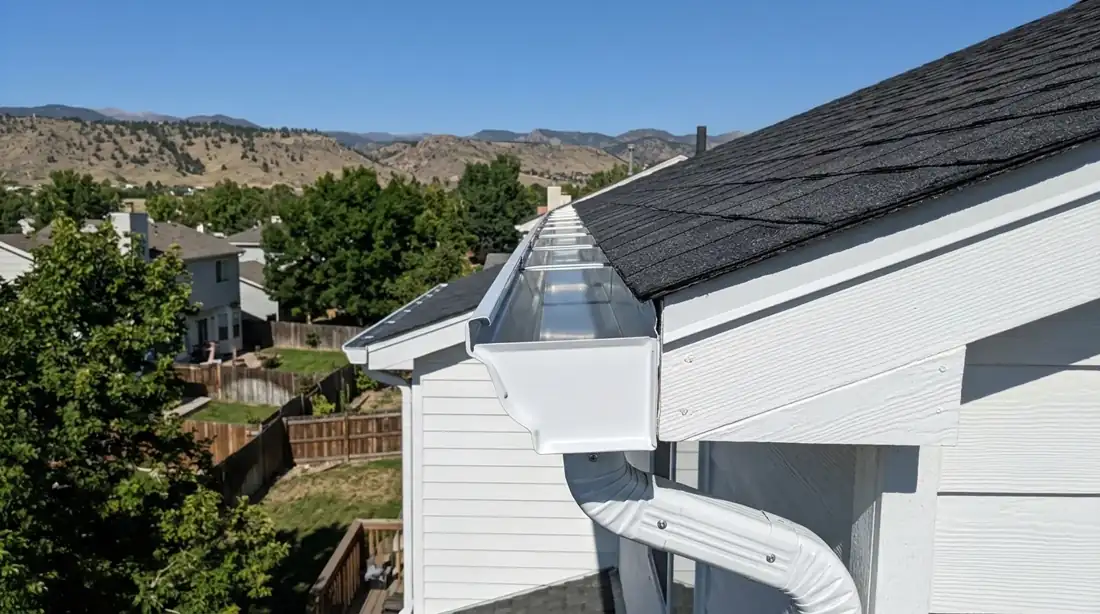
How fast a rain barrel fills in Denver
Every inch of rain on 1,000 square feet of roof is about 623 gallons. Two full barrels hold 110 gallons, so they fill from just 0.18 inch of rain on a 1,000 sq ft roof section. Denver's normal is 14.48 inches a year.
| Roof area draining to the barrel | Rain needed to fill 110 gallons | Water in a normal Denver year |
|---|---|---|
| 500 sq ft of roof to one downspout | 0.35 in | 4,511 gallons |
| 1,000 sq ft of roof to one downspout | 0.18 in | 9,021 gallons |
| 1,500 sq ft of roof to one downspout | 0.12 in | 13,532 gallons |
| 2,000 sq ft of roof to one downspout | 0.09 in | 18,042 gallons |
The lesson: barrels catch the first part of a storm, then overflow. The overflow and the downspout still need to carry water away from the house, and clogged gutters mean the barrel gets leaves and seeds instead of water. A screen on the barrel inlet and clean gutters keep it working.
Where downspout water should go
- Away from the foundation. Denver's expansive clay soils swell when wet. Extensions or splash blocks should carry water several feet out, onto ground that slopes away.
- Onto your own landscaping. Lawns, trees and rain gardens use the water; it is the same idea as the barrel, without the size limit.
- Not across sidewalks or driveways. In Denver's freeze-thaw winters, that water turns into ice where people walk.
- Only clean water to the storm drain. Denver's storm sewers carry rainwater straight to creeks and the South Platte, so nothing but clean rain should reach them.
Keeping a rain barrel working through the year
- Spring: clean gutters after the elm and maple seed drop, or seeds clog the barrel screen.
- Summer: use the water within days so it does not sit; keep the lid sealed.
- Fall: clear leaves from the gutters and barrel inlet.
- Before the first hard freeze: drain the barrel, disconnect it and reconnect the downspout extension, so ice does not split the barrel.
Frequently asked questions
Are rain barrels legal in Denver?
Yes, since 2016. Colorado law (HB16-1005) lets a single-family home, or a building with four units or fewer, use up to two rain barrels with a combined 110 gallons, with no permit, as long as the water is used outdoors on the same property.
How many rain barrels can I have in Colorado?
Two, with a combined capacity of 110 gallons or less. Homes with a qualifying residential well have separate, larger allowances.
Can I drink or use rain barrel water indoors in Denver?
No. Under the rain barrel law the water is for outdoor use only, such as lawns, plants and gardens, on the property where it was collected.
Can my HOA ban rain barrels?
The law lets HOAs set reasonable rules on where a rain barrel goes and how it looks, but they cannot simply forbid them.
Where should my downspouts drain?
Onto your own lawn or planting beds, several feet from the foundation, with the ground sloping away from the house. Only clean rainwater should reach Denver's storm drains, and water aimed at a sidewalk or driveway can freeze into a slip hazard in winter.
← Back to Gutter Cleaning Denver CO