Updated November 2026 · based on NOAA storm records for the city of Denver, 1950-2019
Hail and Your Gutters in Denver: Storm Records, Damage Signs and What to Do
Hail is the one gutter problem in Denver that does not come from trees. We mapped every hail report in NOAA's storm database that fell inside the city's boundary and matched it to Denver's 78 neighborhoods. Here is how often hail hits, how big it gets, and what it does to gutters.
Denver hail season, month by month
Almost all of Denver's hail falls between April and October. The peak is late spring and early summer, when afternoon storms build over the Front Range.
| Month | Hail reports | Share |
|---|---|---|
| April | 12 | 5% |
| May | 64 | 26% |
| June | 92 | 37% |
| July | 51 | 21% |
| August | 18 | 7% |
| September | 7 | 3% |
| October | 2 | 1% |
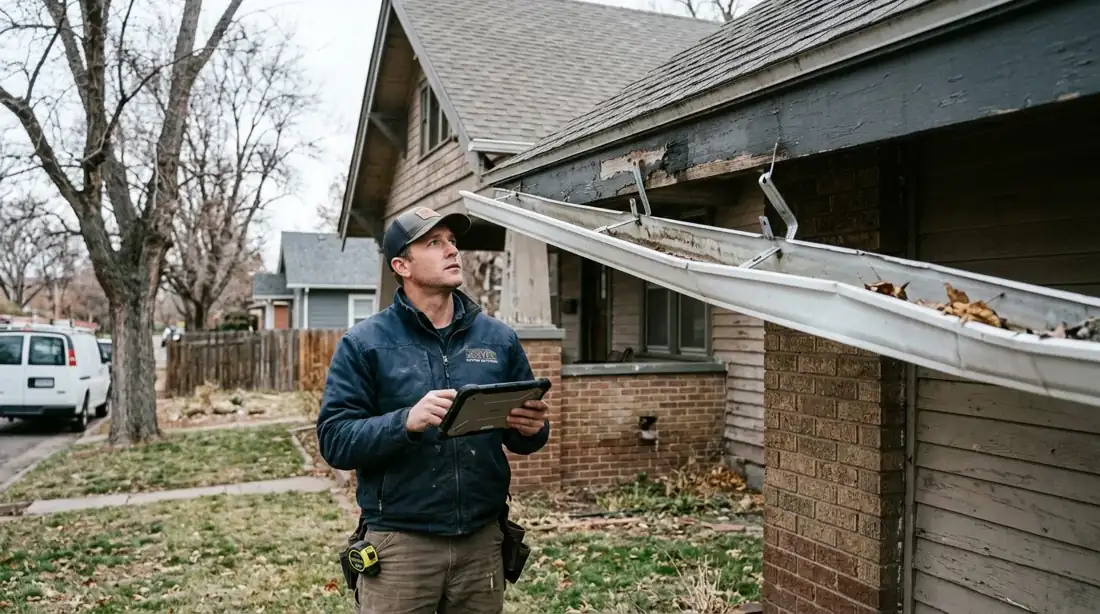
What hail does to gutters
- Dents along the front lip. Thin aluminum gutters dent from hail around one inch. Dents are mostly cosmetic but can trap water and debris.
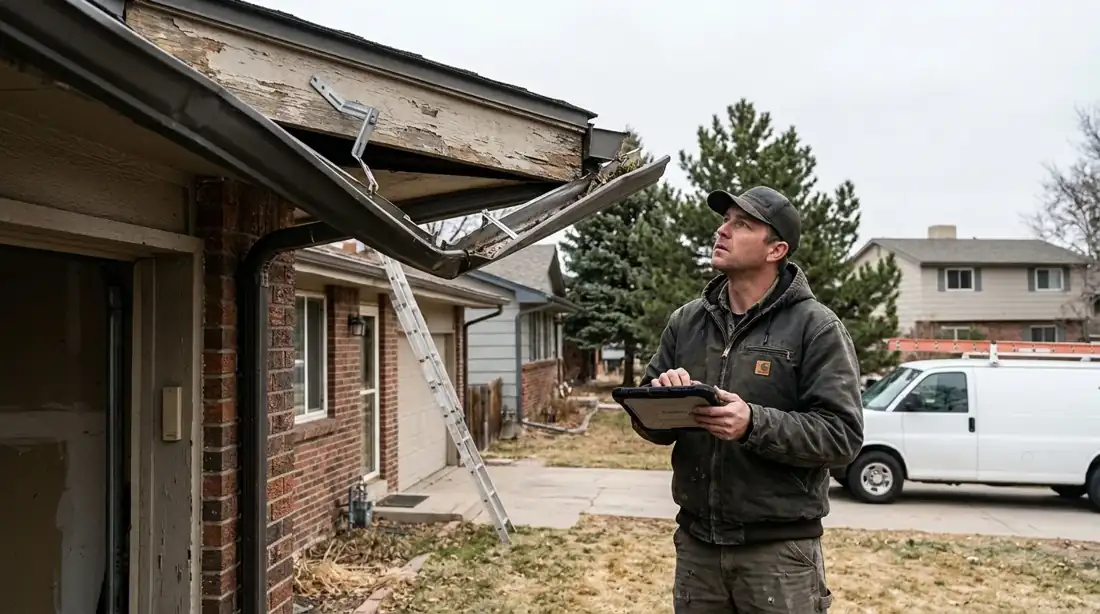
- Crushed or bent downspouts. Downspouts take direct hits and can kink, which slows drainage in the next storm.
- Loose hangers and seams. Heavy hail plus the weight of ice and water can pull hangers loose and open seams.
- Granules and debris. Hail knocks granules off shingles and shreds leaves, and both wash straight into gutters and downspouts.
After a hailstorm: a five-step gutter check
- Wait until the storm has passed and the roof is dry. Look from the ground first.
- Photograph gutters, downspouts and any dents on cars, fences or air-conditioner fins, with the date. Those dents help show the hail size.
- Check inside the gutters for a thick, sand-like layer of shingle granules.
- Run water through the downspouts, or watch the next rain, to make sure nothing is blocked or crushed.
- If you see heavy granules or damage, have the gutters cleaned and the roof inspected before the next storm.
Is hail getting more common in Denver?
Reports by decade rose sharply: 142 of the 246 reports came after 2000. Some of that may be more storms, but much of it is that far more people and weather spotters now report hail than in the 1950s, so older decades are undercounted.
| Decade | Hail reports |
|---|---|
| 1950s | 7 |
| 1960s | 13 |
| 1970s | 14 |
| 1980s | 37 |
| 1990s | 33 |
| 2000s | 58 |
| 2010s | 84 |
Hail reports by area of Denver
| Area | Neighborhoods | Hail reports | Largest hail |
|---|---|---|---|
| East | 4 | 76 | 4.5" |
| Northeast | 1 | 29 | 2" |
| East Central | 6 | 20 | 1.75" |
| Near Southeast | 4 | 16 | 1.75" |
| Far Southwest | 6 | 14 | 2.5" |
| Southeast | 2 | 12 | 1.75" |
| South Central | 4 | 12 | 1.5" |
| Far Northeast | 3 | 11 | 1.75" |
| Southeast Central | 6 | 11 | 1.75" |
| South | 5 | 8 | 1.5" |
| Near Northwest | 4 | 7 | 1.75" |
| Far Southeast | 4 | 6 | 2" |
| West | 6 | 6 | 2.5" |
| Central | 5 | 6 | 1.75" |
| Far Northwest | 4 | 5 | 2" |
| Southwest | 5 | 4 | 1.75" |
| North | 2 | 1 | 1.5" |
| Near Northeast | 5 | 1 | 0.88" |
| North Central | 2 | 1 | 0.75" |
Hail reports in every Denver neighborhood
Reports inside each neighborhood's boundary, the largest hail and the latest year. 35 neighborhoods have no report inside their lines, which does not mean they never get hail: reports are logged where someone measured them, older ones with rounded coordinates, and storms are often miles wide.
| Neighborhood | Hail reports | Largest | Latest |
|---|---|---|---|
| Hale | 73 | 4.5" | 2014 |
| Central Park | 29 | 2" | 2018 |
| Congress Park | 17 | 1.75" | 2017 |
| DIA | 10 | 1.5" | 2019 |
| Windsor | 9 | 1.75" | 2019 |
| Virginia Village | 8 | 1.75" | 2019 |
| Washington Virginia Vale | 8 | 1.25" | 2019 |
| Sunnyside | 6 | 1.75" | 1991 |
| University | 6 | 1.5" | 2019 |
| Washington Park | 6 | 1.75" | 2017 |
| College View - South Platte | 5 | 2.5" | 2004 |
| Platt Park | 5 | 1.5" | 2017 |
| Hampden South | 4 | 2" | 2019 |
| Hilltop | 4 | 1.5" | 2016 |
| Marston | 4 | 1.5" | 2019 |
| Washington Park West | 4 | 1.25" | 2006 |
| Athmar Park | 3 | 1.75" | 1967 |
| City Park West | 3 | 1.12" | 2019 |
| Civic Center | 3 | 1.5" | 2019 |
| Harvey Park | 3 | 1" | 2018 |
| Lincoln Park | 3 | 1.75" | 2017 |
| Lowry Field | 3 | 1.25" | 2006 |
| Speer | 3 | 1.5" | 2015 |
| Barnum West | 2 | 2.5" | 2017 |
| Berkeley | 2 | 1" | 2016 |
| Harvey Park South | 2 | 1.5" | 2016 |
| Regis | 2 | 2" | 2017 |
| South Park Hill | 2 | 1.5" | 2016 |
| Southmoor Park | 2 | 2" | 2016 |
| Villa Park | 2 | 1" | 2019 |
| Barnum | 1 | 0.75" | 1996 |
| Cherry Creek | 1 | 1" | 2019 |
| Clayton | 1 | 0.88" | 2009 |
| East Colfax | 1 | 0.75" | 1979 |
| Elyria Swansea | 1 | 1.5" | 2017 |
| Five Points | 1 | 0.75" | 2007 |
| Highland | 1 | 0.75" | 2019 |
| Montbello | 1 | 1.75" | 2002 |
| Sloan Lake | 1 | 1" | 2019 |
| Sun Valley | 1 | 1" | 2011 |
| University Park | 1 | 1" | 2009 |
| Wellshire | 1 | 0.88" | 2016 |
| Westwood | 1 | 1" | 2011 |
Frequently asked questions
How often does it hail in Denver?
NOAA recorded 246 hail reports inside the city of Denver between 1950 and 2019, 142 of them since 2000. Most fall between May and July, with June the busiest month (92 reports).
Can hail damage gutters?
Yes. Hail around one inch, the size of a quarter, can dent thin aluminum gutters and downspouts, and larger hail can crush them or loosen hangers. 170 of Denver's 246 hail reports were one inch or larger.
What should I check in my gutters after a hailstorm?
Look for dents along the front lip, bent or crushed downspouts, loose hangers and a layer of shingle granules inside the gutter. Heavy granules mean the roof was likely hit too.
Do shingle granules in gutters mean roof damage?
A small amount is normal wear. A thick, sand-like layer right after a hailstorm is a common sign that hail knocked granules off the shingles.
What was the biggest hail ever recorded in Denver?
In the NOAA records we used, the largest was 4.5-inch hail on August 5, 1983. Since 1950, 10 reports in Denver were two inches or larger.
← Back to Gutter Cleaning Denver CO