Updated November 2026 · NWS Boulder climate normals, Colorado Geological Survey, Denver tree inventory and Census housing data
Common Gutter Problems in Denver: Causes, Signs and Fixes
Denver is dry, with a normal of 14.48 inches of precipitation a year, but much of it comes in short, heavy bursts: afternoon thunderstorms, hail and spring snow. That is exactly when a partly blocked gutter fails. Here are the five problems we see asked about most, what causes them in Denver, and which neighborhoods are most at risk.
How much water your roof sends to the gutters
Every inch of rain on 1,000 square feet of roof is about 623 gallons of water. Using Denver's normal yearly precipitation:
| Roof area | One inch of rain | A normal Denver year |
|---|---|---|
| 1,000 sq ft | 623 gallons | 9,021 gallons |
| 1,500 sq ft | 934 gallons | 13,532 gallons |
| 2,000 sq ft | 1,246 gallons | 18,042 gallons |
| 2,500 sq ft | 1,558 gallons | 22,553 gallons |
| 3,000 sq ft | 1,869 gallons | 27,063 gallons |
All of that has to leave through two to four downspouts. One blocked downspout sends its share over the edge of the gutter.
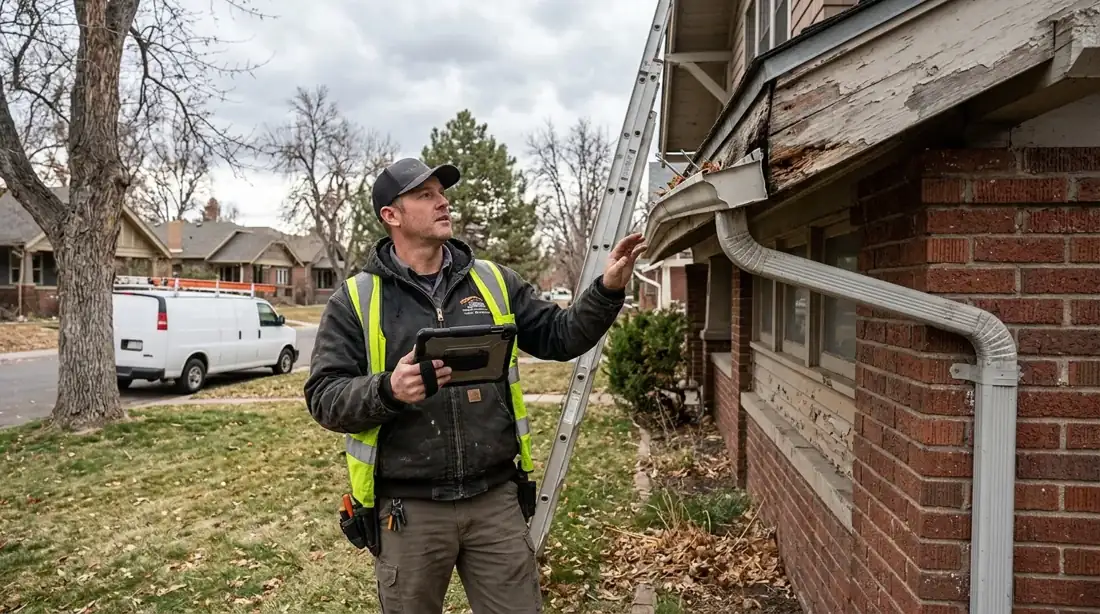
1. Clogged downspouts
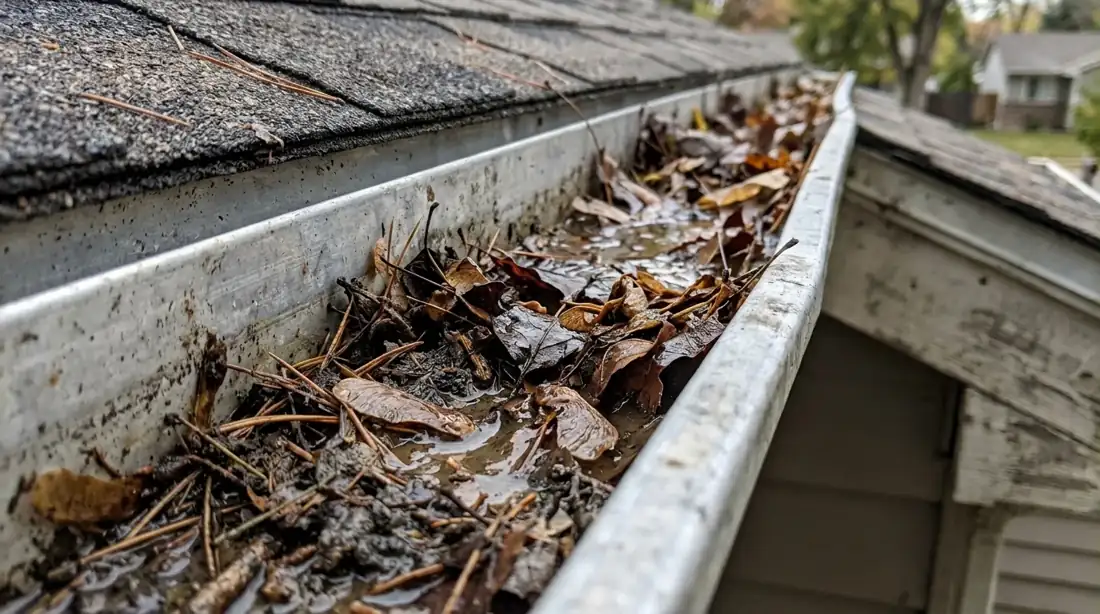
Signs: water pouring over one stretch of gutter in rain, a dry downspout outlet, gurgling, or a downspout that feels heavy. Denver cause: fine debris. Siberian elm seeds in April and May, cottonwood fluff in June and honey locust leaflets in late October are small enough to slide down into the elbow and pack tight. Fix: clear the top opening, flush with a hose, and snake from the bottom if needed. A strainer on the downspout opening helps under elms and locusts.
2. Water at the foundation
Signs: soil washed out under the downspout, damp basement walls, cracks in a basement slab, doors that stick in spring. Denver cause: much of the metro area sits on clay soils that swell when wet and shrink when dry. The Colorado Geological Survey calls expansive soil the state's most costly geologic hazard and stresses gutters, downspouts and extensions in good working order. Fix: keep gutters flowing, add downspout extensions or splash blocks that carry water well away from the house (five feet or more is a common rule), and keep the ground sloping away from the walls.
3. Leaking seams and corners
Signs: drips from corners or joints, rust or paint stains on the siding, icicles forming at the same spot every winter. Denver cause: freeze-thaw. Sunny winter days and freezing nights expand and shrink metal and sealant, and old sealant cracks. Fix: clean and dry the joint and reseal it with gutter sealant. Long runs of sectional gutter with many seams leak more than seamless gutters.
4. Sagging or pulling away
Signs: a dip where water pools, gaps between gutter and fascia, spikes backing out of the board. Denver cause: weight from wet debris, ice and spring snow, plus old spike-and-ferrule fasteners. Homes built before 1950 are the most likely to have soft fascia behind the gutter. Fix: clean the gutter first, then re-hang it with hidden hangers screwed into sound wood and restore the slope toward the downspout.
5. Standing water and mosquitoes
Signs: water still sitting in the gutter days after rain, or a line of muck along the bottom. Denver cause: a gutter that lost its slope or is partly clogged. Standing water can breed mosquitoes, including the Culex species that carry West Nile virus in Colorado. Fix: clean the gutter and correct the slope so it drains completely.
Gutter problem risk in every Denver neighborhood
Downspout clog risk combines canopy (Denver average 15.5%) with the share of public trees that drop fine debris: seeds, fluff, leaflets and needles. "High" means both are above our thresholds; there are 33. Age comes from the median year homes were built (U.S. Census ACS); 14 neighborhoods have a median before 1950.
| Neighborhood | Median year built | Canopy | Fine-debris trees | Downspout clog risk | Age check |
|---|---|---|---|---|---|
| Athmar Park | 1953 | 11.8% | 41% | Medium | Check seams |
| Auraria | 1938 | 6.7% | 32% | Medium | Check hangers and fascia |
| Baker | 1993 | 7.0% | 29% | Medium | Newer homes |
| Barnum | 1950 | 15.2% | 40% | Medium | Check seams |
| Barnum West | 1956 | 16.3% | 45% | High | Check seams |
| Bear Valley | 1974 | 20.8% | 48% | High | Check seams |
| Belcaro | 1983 | 27.5% | 34% | High | Newer homes |
| Berkeley | 1948 | 19.2% | 27% | High | Check hangers and fascia |
| CBD | 1976 | 3.9% | 46% | Medium | Check seams |
| Capitol Hill | 1961 | 18.2% | 30% | High | Check seams |
| Central Park | 2010 | 0% | 24% | Low | Newer homes |
| Chaffee Park | 1950 | 11.7% | 34% | Medium | Check seams |
| Cheesman Park | 1961 | 28.6% | 30% | High | Check seams |
| Cherry Creek | 1997 | 14.8% | 23% | Low | Newer homes |
| City Park | 1966 | 23.7% | 36% | High | Check seams |
| City Park West | 1972 | 20.0% | 22% | Medium | Check seams |
| Civic Center | 2010 | 8.3% | 26% | Medium | Newer homes |
| Clayton | 1952 | 13.4% | 32% | Medium | Check seams |
| Cole | 1938 | 12.8% | 29% | Medium | Check hangers and fascia |
| College View - South Platte | 1976 | 10.7% | 54% | Medium | Check seams |
| Congress Park | 1947 | 29.4% | 22% | Medium | Check hangers and fascia |
| Cory - Merrill | 1952 | 19.6% | 26% | High | Check seams |
| Country Club | 1938 | 34.1% | 27% | High | Check hangers and fascia |
| DIA | 2013 | 1.3% | 21% | Low | Newer homes |
| East Colfax | 1957 | 21.0% | 44% | High | Check seams |
| Elyria Swansea | 1956 | 5.2% | 31% | Medium | Check seams |
| Five Points | 2010 | 7.8% | 27% | Medium | Newer homes |
| Fort Logan | 1974 | 16.1% | 54% | High | Check seams |
| Gateway - Green Valley Ranch | 2005 | 2.9% | 26% | Medium | Newer homes |
| Globeville | 1987 | 4.8% | 32% | Medium | Newer homes |
| Goldsmith | 1972 | 16.9% | 51% | High | Check seams |
| Hale | 1960 | 24.9% | 31% | High | Check seams |
| Hampden | 1974 | 19.0% | 48% | High | Check seams |
| Hampden South | 1977 | 17.4% | 38% | High | Check seams |
| Harvey Park | 1956 | 16.3% | 39% | High | Check seams |
| Harvey Park South | 1958 | 19.8% | 35% | High | Check seams |
| Highland | 2001 | 13.5% | 21% | Low | Newer homes |
| Hilltop | 1968 | 27.4% | 42% | High | Check seams |
| Indian Creek | 1986 | 13.7% | 59% | Medium | Newer homes |
| Jefferson Park | 2012 | 10.3% | 36% | Medium | Newer homes |
| Kennedy | 1980 | 9.5% | 61% | Medium | Newer homes |
| Lincoln Park | 1983 | 6.6% | 32% | Medium | Newer homes |
| Lowry Field | 2002 | 5.2% | 20% | Low | Newer homes |
| Mar Lee | 1957 | 16.6% | 42% | High | Check seams |
| Marston | 1988 | 8.6% | 25% | Low | Newer homes |
| Montbello | 1977 | 9.2% | 38% | Medium | Check seams |
| Montclair | 1948 | 28.7% | 40% | High | Check hangers and fascia |
| North Capitol Hill | 1996 | 12.0% | 30% | Medium | Newer homes |
| North Park Hill | 1943 | 21.7% | 30% | High | Check hangers and fascia |
| Northeast Park Hill | 1957 | 5.7% | 45% | Medium | Check seams |
| Overland | 2004 | 8.5% | 51% | Medium | Newer homes |
| Platt Park | 1939 | 20.4% | 20% | Medium | Check hangers and fascia |
| Regis | 1953 | 15.4% | 55% | Medium | Check seams |
| Rosedale | 1953 | 18.0% | 36% | High | Check seams |
| Ruby Hill | 1957 | 13.4% | 44% | Medium | Check seams |
| Skyland | 1950 | 14.1% | 35% | Medium | Check seams |
| Sloan Lake | 1955 | 15.1% | 28% | Medium | Check seams |
| South Park Hill | 1939 | 33.0% | 31% | High | Check hangers and fascia |
| Southmoor Park | 2006 | 14.4% | 35% | Medium | Newer homes |
| Speer | 1965 | 19.8% | 25% | High | Check seams |
| Sun Valley | 2016 | 3.5% | 35% | Medium | Newer homes |
| Sunnyside | 1946 | 15.9% | 22% | Medium | Check hangers and fascia |
| Union Station | 2010 | 4.7% | 46% | Medium | Newer homes |
| University | 1954 | 21.6% | 30% | High | Check seams |
| University Hills | 1960 | 19.9% | 44% | High | Check seams |
| University Park | 1976 | 25.6% | 34% | High | Check seams |
| Valverde | 1956 | 8.0% | 39% | Medium | Check seams |
| Villa Park | 1955 | 14.7% | 47% | Medium | Check seams |
| Virginia Village | 1964 | 21.5% | 40% | High | Check seams |
| Washington Park | 1942 | 24.2% | 27% | High | Check hangers and fascia |
| Washington Park West | 1939 | 19.5% | 18% | Medium | Check hangers and fascia |
| Washington Virginia Vale | 1973 | 16.8% | 45% | High | Check seams |
| Wellshire | 1957 | 23.4% | 43% | High | Check seams |
| West Colfax | 2006 | 13.2% | 32% | Medium | Newer homes |
| West Highland | 1939 | 19.9% | 20% | Medium | Check hangers and fascia |
| Westwood | 1958 | 13.2% | 46% | Medium | Check seams |
| Whittier | 1938 | 18.8% | 26% | High | Check hangers and fascia |
| Windsor | 1977 | 16.4% | 47% | High | Check seams |
Frequently asked questions
Why is water coming over the top of my gutters?
Usually a clogged gutter or downspout. In Denver the usual culprits are elm seeds, honey locust leaflets and pine needles packed into the downspout opening. Less often the gutter has lost its slope, or a summer cloudburst simply dumps more water than a small gutter can carry.
How do I unclog a gutter downspout?
Clear the debris from the top opening first, then run a garden hose down the downspout from the top. If the water backs up, push it through from the bottom with a plumber's snake. If the downspout is crushed or full of packed seeds, it is usually faster to take it apart.
Can clogged gutters damage my foundation in Denver?
Yes. The Colorado Geological Survey calls expansive, swelling soil Colorado's most costly geologic hazard, and it stresses keeping gutters, downspouts and extensions working so roof water ends up well away from the foundation.
Why are my gutters sagging or pulling away from the house?
Weight and loose fasteners. Gutters full of wet debris, ice or snow pull on the hangers, and on older homes the fascia board behind them may be soft. Re-fastening with modern hidden hangers fixes most sagging gutters if the wood is still sound.
Do clogged gutters attract mosquitoes?
They can. Gutters that hold standing water for a week or more give mosquitoes a place to breed, including Culex mosquitoes, which spread West Nile virus in Colorado. A gutter that drains fully after rain does not.
← Back to Gutter Cleaning Denver CO